Kimi K3 Review: Model Capabilities, Coding Performance and API Access
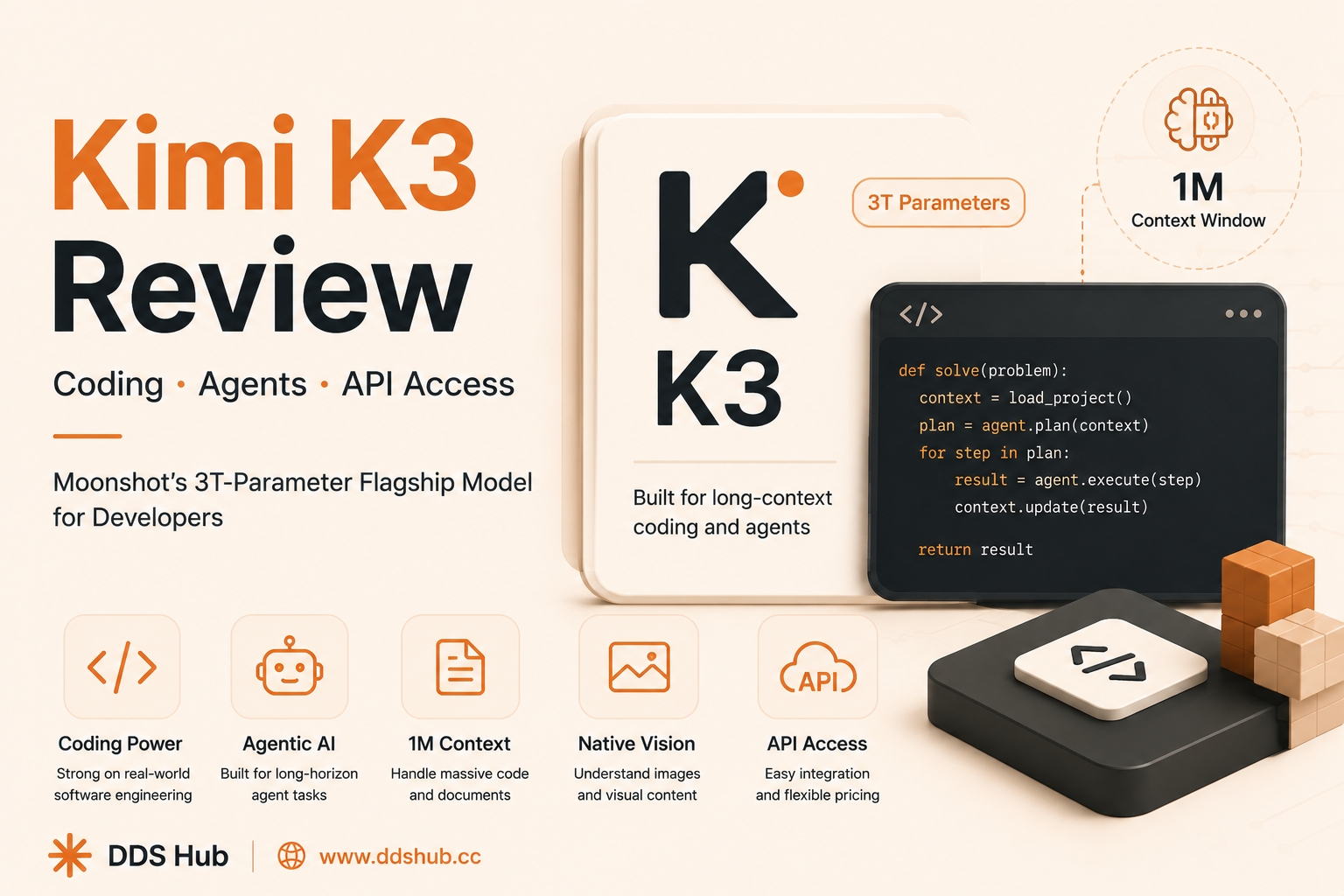
Kimi K3 has quickly become one of the most interesting AI models for developers looking for a combination of coding ability, long-context reasoning and agentic workflows.
Released by Moonshot AI in July 2026, Kimi K3 is positioned as the company's most capable model so far. Moonshot describes it as the world's first open model in the 3-trillion-parameter class, with approximately 2.8 trillion parameters, a native vision capability and a 1-million-token context window.
For developers, however, the most important question is not simply how large the model is. The real question is whether K3 can turn that scale into useful performance when working with real software projects, long documents and multi-step agents.
The answer is increasingly interesting.
Kimi K3 Is Built for Long-Horizon Tasks
Kimi K3 is based on Moonshot's Kimi Delta Attention architecture and Attention Residuals. These architectural choices are designed to improve the model's ability to process long sequences while maintaining efficient reasoning.
The most obvious practical advantage is the 1M-token context window.
For ordinary chatbot conversations, a million-token context may be excessive. For coding agents, however, it can be extremely useful.
A large software repository can contain hundreds of files, documentation, configuration files and test cases. Instead of constantly compressing or removing older context, an agent can retain substantially more information about the project while working on a complicated task.
Kimi's own documentation positions K3 for large-codebase analysis, multi-file refactoring and long-document processing.
This makes K3 particularly relevant to developers using tools such as Kimi Code, Claude Code, Codex and other repository-level coding agents.
Kimi K3 and Coding
Coding is arguably one of the strongest reasons to pay attention to Kimi K3.
Kimi describes K3 as a model designed for long-horizon coding and Agentic Coding. It can analyze large codebases, interact with terminal tools and adjust its approach based on feedback from the development environment.
This is an important distinction from traditional code-generation models.
A simple coding assistant might answer:
"Here is the JavaScript function you requested."
A coding agent needs to do much more. It may need to locate the correct files, understand the architecture, modify several components, run tests, inspect errors and make additional changes.
K3 is designed for this type of workflow.
Recent independent evaluations also suggest that Kimi K3 is competitive on software-engineering tasks. A recent OdinEval program-repair benchmark reported Kimi K3 achieving the highest resolved score among the models tested, at 66.7%.
These results should not be interpreted as proof that K3 is universally the best coding model, because benchmark design and agent harnesses can significantly affect results. However, they reinforce the idea that K3 is a serious coding model rather than simply a general-purpose chatbot.
Kimi K3 as an Agent Model
Another important characteristic of K3 is its focus on agentic workflows.
Kimi's documentation describes K3 as particularly suitable for Agent tasks, while Kimi K3-powered Agent Swarm is designed for large-scale parallel search and batch processing.
This matters because modern AI applications increasingly require models to complete a sequence of actions rather than generate one response.
For example, an AI research agent may need to search multiple sources, extract information, compare results and produce a final report. A coding agent may need to inspect a repository, edit files, run tests and debug failures.
K3 is designed around this longer interaction loop.
There is also growing research showing that Kimi K3 can benefit significantly from well-designed agent harnesses. A recent study on self-orchestration found a substantial improvement for Kimi K3 on a coding benchmark when a manager-worker architecture was introduced, illustrating that the model's performance depends not only on the model itself but also on how the surrounding agent system is designed.
For developers, this means that choosing a good harness, context strategy and tool configuration can be just as important as choosing K3 itself.
Kimi K3 Supports Different Reasoning Levels
K3 supports configurable reasoning effort, including low, high and max.
The default reasoning level is high, while developers can select a different level depending on the task.
This can be useful when optimizing an AI application.
A simple code completion request does not necessarily need maximum reasoning. A complex architecture migration or difficult debugging problem may benefit from a higher reasoning budget.
The important point is to avoid assuming that maximum reasoning is always better. More reasoning can increase latency and token consumption, so production applications should choose the setting according to the complexity of the task.
Kimi K3 1M vs K3-256K
Kimi now provides two K3 model IDs that are particularly relevant to API and coding users: k3 and k3-256k.
The k3 version supports up to a 1M-token context window for eligible usage, while k3-256k is limited to 256K tokens. Kimi states that within the 256K context range, K3-256K provides the same results while consuming approximately half the quota of the 1M version.
This creates an interesting optimization strategy.
For everyday coding, code completion and smaller changes, K3-256K may provide a better cost-performance ratio. When an agent needs to understand a very large repository or maintain a long-running context, the 1M version becomes more attractive.
Developers should therefore avoid automatically using the 1M version for every request.
Kimi K3 API Pricing
Kimi's official API pricing is another reason the model has attracted attention.
Moonshot currently lists Kimi K3 at approximately **\(0.30 per million tokens for cache-hit input, \)3 per million tokens for cache-miss input and $15 per million tokens for output**.
In the Chinese pricing information, this corresponds to approximately RMB 2 per million cached input tokens, RMB 20 per million uncached input tokens and RMB 100 per million output tokens. Moonshot also reports that its coding workloads can achieve a cache hit rate above 90% through its Mooncake infrastructure.
For long-context coding agents, caching is particularly important because the same repository context can be reused across multiple turns.
The effective cost of a K3 application therefore depends not only on the model's nominal token price, but also on context reuse, reasoning level, prompt size and agent architecture.
Kimi K3 API and Developer Tools
Kimi has also made K3 relatively easy to integrate into existing developer workflows.
The Kimi API supports OpenAI-compatible access, while Kimi Code provides an Anthropic-compatible endpoint as well. The official documentation lists both OpenAI and Anthropic protocols for Kimi Code.
This means developers can integrate K3 into coding tools that already support these API conventions instead of building a completely new integration from scratch.
Kimi's documentation specifically provides integration guidance for tools such as Claude Code, OpenCode and Codex.
This is one of the reasons K3 is particularly interesting for developers who already have an AI coding workflow.
Why Use Kimi K3 Through DDS Hub?
For developers who want to experiment with Kimi K3, managing different AI providers, API keys and billing systems can become inconvenient, especially when the same development environment is also using Claude, Codex or GLM.
DDS Hub, also known as 呆呆兽中转站, provides Kimi K3 access as part of its multi-model API platform.
This gives developers another way to integrate Kimi K3 into coding applications and AI workflows while keeping Kimi alongside other models such as Claude, Codex and GLM.
The advantage of a multi-model platform is that developers do not have to decide on a single model for every workload. Kimi K3 can handle long-context coding and agent tasks, Claude can be used for particular reasoning or coding workflows, while Codex and GLM can be evaluated for other development workloads.
DDS Hub currently offers Kimi K3 at 8折, making it an option worth considering for developers who want to test K3 while keeping API costs under control.
You can check the latest models and pricing here:
Is Kimi K3 Worth Using?
Kimi K3 is most compelling when its long-context and agentic capabilities actually matter.
For simple questions or short code snippets, a smaller model may be faster and cheaper. But when the task involves a large repository, long technical documents, multi-file refactoring or an agent that needs to maintain context across many steps, K3's 1M-token context and reasoning capabilities become much more valuable.
The availability of K3-256K also gives developers a more economical option for everyday workloads.
Rather than treating K3 as a universal replacement for every AI model, it makes more sense to view it as another powerful component in a multi-model development stack.
Final Thoughts
Kimi K3 represents an important step in the development of open AI models.
Its combination of 2.8T parameters, 1M context, native vision, configurable reasoning and agentic coding capabilities makes it particularly relevant to developers building coding agents and long-running AI applications.
Its biggest advantage may not be any single benchmark score. Instead, it is the combination of model scale, long context and the ability to work inside increasingly sophisticated agent workflows.
For developers building AI applications, the best way to evaluate K3 is therefore to test it against real workloads: large repositories, complex debugging tasks, long-context analysis and multi-step agents.
And for developers looking for a convenient way to access Kimi K3 alongside Claude, Codex and GLM, DDS Hub provides a multi-model API option with Kimi K3 currently available at 8折.